The Chicago Blackhawks are one of hockey’s most recognizable franchises through a century of history, championship success, and legendary players. Beyond the ice, the organization continues to make an impact through legacy and its lasting connection to the city of Chicago.
History
The Chicago Blackhawks are one of six teams currently in the NHL that was a part of the NHL’s original expansion. The Blackhawks (formerly the Black Hawks) were added as part of a rapid U.S. expansion in 1926. By the 1942-43 season the only six NHL teams were all teams that still exist today: the New York Rangers, Detroit Red Wings, Boston Bruins, Montreal Canadiens, and the Toronto Maple Leafs, all known as the original six. The Blackhawks won their first Stanley Cup in the 1933-34 season, again in 1938, and for the last time with the six-team NHL
Blackhawks Legacy
Throughout their 100 year franchise history, the Chicago Blackhawks have made many achievements and held numerous records. The Blackhawks have won the Stanley Cup, the highest team achievement in the NHL, six times. Steve Larmer, who played with the Blackhawks from 1982-1993, holds the NHL record for most consecutive games played with one franchise with 884 games. Additionally, Chris Chelios, who played for Chicago from 1990-1999, holds the record for most penalty minutes in a season. He logged 1,495 minutes during his time in Chicago.
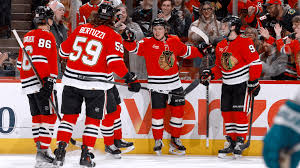
Perhaps most famously, Bobby Hull, who played with the Blackhawks from 1957-1972, was the first player in NHL history to score over 50 goals in a single season, with 54 in 1966. His career best was 58 in the 1968-69 season, this record is now held by Wayne Gretzky with 92.
Notable Players
Throughout its franchise history, the Chicago Blackhawks have been represented by many of hockey’s most legendary and recognizable players. Bobby Hull became one of the first true superstars of the sport and helped bring national attention to the organization. Stan Mikita, another franchise legend who played for Chicago from 1958-80, remains one of the most accomplished players in team history. In more recent years, Jonathan Toews and Patrick Kane helped lead the Blackhawks to three Stanley Cup championships in 2010, 2013, and 2015. Their leadership and success introduced a new generation of fans to the franchise and strengthened the team’s legacy in the modern NHL.
Communi
In addition to being a central part of the Chicago community, the Blackhawks engage with the local community in a multitude of ways. They have the Chicago Blackhawks Foundation, which aims to create healthy and secure environments for families in the community. Some of their initiatives include supporting youth education with reading programs, promoting healthy living through G.O.A.L. community organizations, and their partnerships with Trickster Cultural Center. The Blackhawks are committed to community engagement and supporting local initiatives, they also participate in broader hockey charities, such as Hockey Fights Cancer.
Fan Culture and Tradition
Like many NHL teams, the Blackhawks hold many special fan traditions. The atmosphere at the United Center, their current home rink, is known to be high energy and passionate. Famously, the Blackhawks fans sing “Chelsea Dagger” by the Fratellis, every time the Blackhawks score during home games. This is perhaps one of the most beloved fan traditions for Chicago. Furthermore, Blackhawks fans are known to cheer loudly during the national anthem, particularly during playoff games. This tradition was started in 1985 during a playoff series as a way for fans to energize the team and has remained ever since.
For a century, the Chicago Blackhawks have remained one of hockey’s most recognizable franchises. From their place in NHL history as an Original Six team to their record-setting players and commitment to community impact, the organization represents more than a sport and records. The Blackhawks have built a legacy rooted in tradition, resilience, and connection with the Chicago community. As the franchise looks toward the future, its lasting influence on the sport and the city continues to make it an important part of the NHL story.


Leave a Reply